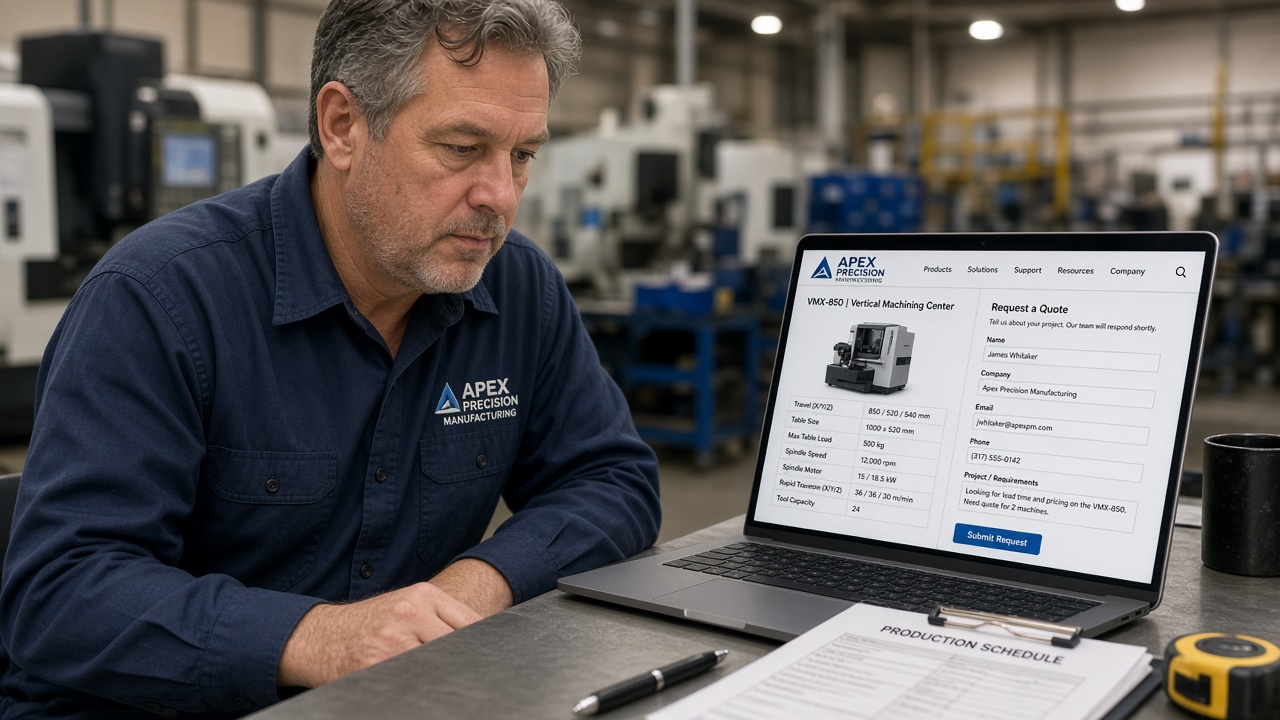
A plant manager called us last spring looking for a new quote request page. What he actually needed came out twenty minutes into the call: his sales team had lost a bid to a competitor two states away, and the customer admitted the other company’s website had made it easier to send a spec sheet and get a number back. Same capability. Same price range, probably. The order went to whoever was easier to reach.
That’s the story behind this post. Not SEO theory, a lost order.
Why “we get all our work by referral” stopped being enough
Most manufacturers and industrial suppliers we talk to built their business on relationships: a sales rep who golfs with the right buyer, a reputation that travels through an industry association, a distributor who’s carried your line for fifteen years. That still works. We’re not telling you to abandon it.
What’s changed is who else is in the room before that relationship ever starts. A purchasing manager at a new account, someone who doesn’t know your rep yet, is going to look you up before they call. If what they find is a five-page site built in 2014 with a PDF catalog and a “contact us for pricing” form, they’ll assume you’re either small, outdated, or not worth the trouble of chasing down a quote. None of those are true. All of them cost you the RFQ.
The honest counter-argument: if every customer you’ll ever have comes through a trade show booth or a cousin in purchasing, a website barely matters. Some shops genuinely run that way, and for them this is a low-priority project. But if you want to grow past the accounts your current rep already knows, the website is doing real work whether you’ve decided to use it or not.
How industrial buyers actually research now
Business buyers, including the engineers and purchasing agents who source industrial parts, do a lot of their homework alone before they ever talk to a salesperson. They search for a part number, a material spec, a process capability, or a certification. They compare two or three vendors side by side. By the time they reach out, they’ve usually already narrowed the field.
If your site doesn’t show up in that search, you’re not in the field at all. And if it shows up but doesn’t answer their first question, like whether you can hold a tolerance, run a minimum order quantity, or ship to their region, they move to the next tab.
This is the part that trips up a lot of industrial sites: they’re written for someone who already knows the company. “Precision machining since 1987, family owned, quality you can trust.” True, probably. Not what a buyer searching for “CNC aluminum parts under 500 pieces” needs to know in the first five seconds.
We pulled apart exactly this pattern in a teardown of three real manufacturer websites, and it shows up on every one of them: company history up front, the buyer’s question nowhere near it.
What your site needs: specs, capabilities, RFQ paths
A manufacturer’s site has one job a restaurant’s or a law firm’s doesn’t: it has to answer a technical question fast, for someone who is comparing you against two competitors in other browser tabs right now.
That means:
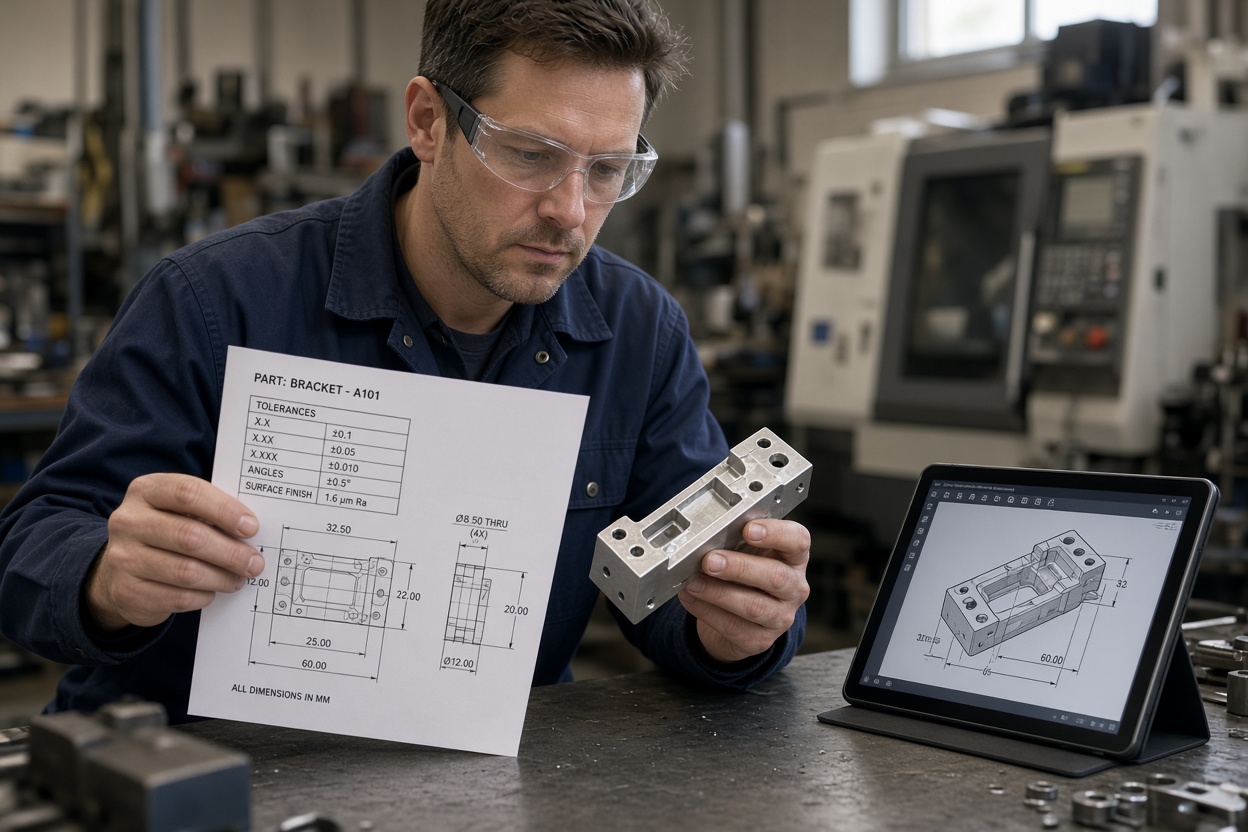
- Capabilities stated in buyer language. Materials you work with, tolerances you hold, volumes you run, certifications you carry. Not “state of the art facility.” The actual numbers.
- Spec sheets and drawings a buyer can download without emailing anyone first. Gatekeeping a PDF behind a contact form is a habit left over from when every lead had to go through a rep. It now reads as friction, and a buyer with two other tabs open won’t fill out the form.
- A real RFQ path. Not just a generic “Contact Us” form. A request form that asks for the information a quote requires: part number, quantity, material, drawing upload, so your sales team gets a usable lead instead of “please call me.”
- Proof you can run at their scale. Equipment list, floor square footage, shift schedule if it’s relevant, lead time ranges. Buyers vetting a new supplier are often checking whether you can handle their volume without becoming their only option if you go under.
One more thing buyers check that gets overlooked: whether the site works on a phone. A lot of industrial buying still starts on a desktop in an office, but plenty of it happens on a tablet on the shop floor or a phone in a truck between job sites, especially for maintenance and repair parts ordered under time pressure. A site that only works at a desk loses that buyer at the exact moment they’re ready to order.
None of this requires a flashy site. It requires a site that was built by someone who sat down and thought about what a purchasing agent needs to know, not what looks good in a portfolio. That’s the same thinking behind our web design and development work: start with what the buyer needs, not what wins awards.
The distributor conflict: selling online without undercutting them
Here’s where a lot of manufacturers stall out, and it’s a legitimate concern, not an excuse. If you sell through distributors, putting pricing and an order button directly on your own site can look like you’re competing with the people who’ve been selling your product for years. That relationship is worth protecting. We’re not telling you to blow it up.
The fix isn’t to avoid the website, it’s to be deliberate about what it does. A site can generate leads, answer technical questions, and route a buyer to the right distributor for their region, all without taking a direct sale that should go through the channel. Some manufacturers add a “where to buy” page with a distributor locator instead of a cart. Others reserve direct online ordering for products or order sizes the distributor network doesn’t cover, like small prototype runs or discontinued parts.
We worked through this with a Midwest fabricator a few years back who sold almost entirely through two regional distributors. He didn’t want a storefront, and he was right not to want one. What he needed was a site his distributors’ own sales reps could point customers to for drawings and tolerances, with every inquiry routed back to “find your local distributor” instead of a buy button. His distributors ended up linking to his spec pages from their own catalogs, because it saved their reps a phone call. The site helped the channel instead of competing with it.
Talk to your distributors about this before you build it. The worst version of this project is the one where a distributor finds out from a customer that you’re now selling direct, instead of hearing it from you first.

Search terms your buyers use that you don’t
Manufacturers tend to describe their own work the way they talk about it internally. A buyer searches differently. Finding that buyer vocabulary and building it into your pages is the core of our search engine optimization work for manufacturers. If your team calls a process “secondary machining” internally, a buyer might search “deburring services near me” or “post-machining finishing.” If you make a part for the ag industry, you might describe it by part family while the buyer searches by the equipment it goes into, “combine header parts” rather than “custom steel fabrication.”
The same gap shows up in how you describe industries you serve. A company that supplies parts to grain co-ops might think of the customer as “agricultural equipment manufacturers.” The buyer at that co-op is searching “replacement parts for grain augers” or the name of the specific machine. If your page only says “agricultural sector,” you’ll never show up for the search that actually finds you a buyer.
This is a real gap, and it’s fixable without guesswork: pull the actual search terms people use to find suppliers like you, including the specific equipment, materials, and industries you serve, and make sure that language shows up on the page, not just your internal shorthand. A site that only uses your company’s internal vocabulary is invisible to the buyer searching in theirs.
What a realistic first phase looks like
Certifications are another place buyers get stuck. If you carry ISO 9001, AS9100, or an industry-specific certification, don’t bury it in a downloadable PDF on a compliance page nobody finds. Put it where a buyer comparing vendors will see it: on the capabilities page, next to the claim it backs up.
You don’t need to rebuild everything at once, and we’d tell you not to. A realistic first phase usually looks like this: a capabilities page written in buyer language, downloadable specs and drawings without a form wall, a working RFQ form that collects the right fields, and the handful of search terms your actual buyers use built into the pages that answer them. That’s a scoped project, not a six-month overhaul, and it’s the part that pays back fastest.
The plant manager from the start of this post ended up doing exactly that. We didn’t touch his distributor pricing or rebuild his whole site in one pass. We fixed the capabilities page and the quote form first, because that was the gap that had already cost him a bid.
If you want a second set of eyes on where your site is losing RFQs before it reaches your sales team, we offer a manufacturing website assessment. We’ll walk through your current site the way a buyer would and tell you plainly what’s working and what isn’t.
